Too much governance, not enough leadership: when control slows down your projects

In our last article on governance, we addressed an important observation: when governance isn’t working, the problem doesn’t necessarily stem from its structure.
Roles can be defined. Committees can be in place. Approval mechanisms can be documented. And yet, projects can still slow down, and decisions can become increasingly difficult to make.
However, there’s another phenomenon we observe in transformation projects: when leadership is lacking, organizations sometimes tend to add more governance to compensate.
This involves adding:
- an additional committee;
- a new validation process;
- another level of approval;
- more meetings and follow-ups;
- new control mechanisms.
The intention is generally good: to better manage the project and reduce risks.
But beyond a certain point, this additional governance no longer secures the project. It creates roadblocks.
La gouvernance ne devrait pas remplacer la prise de décision
Good governance should allow an organization to clearly understand who decides, on what matters, and when.
Its goal is not to pass every decision through the hands of as many people as possible.
Yet, when an organization lacks leadership or when decision-makers hesitate to take responsibility for certain decisions, a process that should be simple can quickly become:
- consultation;
- validation;
- second validation;
- escalation to a higher level;
- waiting for the next committee meeting;
- final decision.
The decision may eventually be made, but in the meantime, the project has lost several days, or even several weeks.
The invisible cost of over-governance
These delays may seem relatively insignificant when viewed individually.
An additional two-day approval. A meeting postponed to the following week. A decision that ultimately has to go back to the steering committee.
But in a transformation project involving dozens or hundreds of decisions, these delays accumulate.
This is where a form of organizational bottleneck emerges:
- Time spent preparing for meetings that don’t lead to a decision;
- Teams waiting for approval before they can move forward;
- Managers producing more information to reassure decision-makers;
- Decisions already discussed that are reopened;
- Resources tied up for longer than necessary;
- Deadlines that are progressively extended.
Meanwhile, the project continues to consume time, energy, and resources.
The problem is therefore no longer simply administrative. It becomes operational and financial.
Leadership enables decision-making within the framework
This is where the distinction between governance and leadership becomes important.
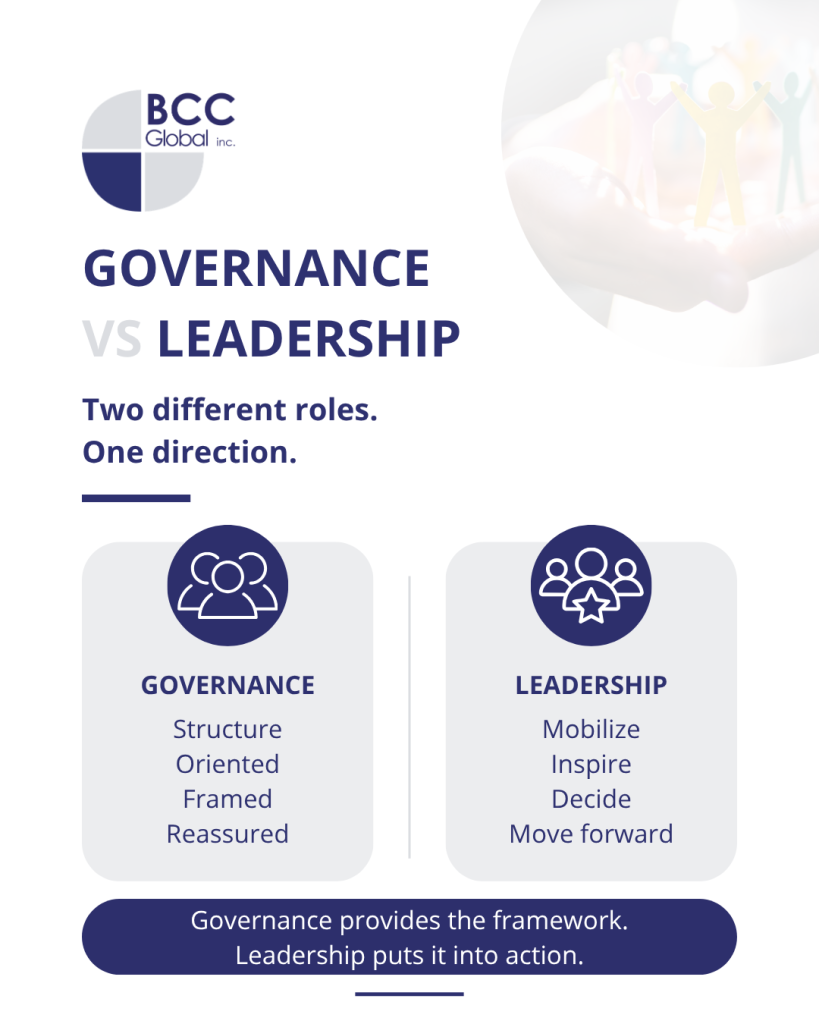
Governance establishes the framework within which decisions must be made.
Leadership enables those decisions to be taken responsibility and the organization to move forward within that framework.
When responsibilities, objectives, and boundaries are clear, leaders should be able to:
- make the decisions that fall within their purview;
- act with an appropriate level of autonomy;
- accept the consequences of their decisions;
- communicate clear direction;
- mobilize teams around the decisions made;
- and intervene quickly when obstacles arise.
Without this leadership, even an excellent governance structure can become cumbersome.
Every uncertainty escalates. Every risk requires approval. Every disagreement becomes a new meeting.
Gradually, governance then begins to manage decisions that should be made directly by the responsible individuals.

More control does not necessarily mean less risk
This is one of the paradoxes of over-governance.
Adding control mechanisms may give the impression of reducing risk. But when these mechanisms significantly slow down decision-making, they can themselves become a source of risk.
In a transformation project:
- some initial assumptions will need to be adjusted;
- unforeseen problems will arise;
- new information will influence decisions;
- some priorities will need to evolve;
- decisions will sometimes need to be made quickly with imperfect information.
An organization unable to make decisions without involving multiple levels of governance then loses some of its adaptability.
The question to ask is therefore not only:
“Do we have enough controls?”
But also:
“Have we given the right people the necessary authority to decide?”
How can you tell if your project is suffering from too much governance?
Several signs should raise red flags:
- The same decisions are repeated in multiple committees;
- Teams regularly await approval before proceeding;
- Managers are accountable for results but have little decision-making autonomy;
- Meetings are used more for information sharing than decision-making;
- Operational issues are constantly escalated to senior management;
- Several people must approve relatively simple decisions;
- Decisions already made are regularly challenged;
- No one seems willing to make the final decision.
In these situations, adding a new structure will likely not solve the problem.
Instead, the question should be whether the current level of leadership, autonomy, and accountability is sufficient.
In these situations, adding a new structure will likely not solve the problem.
The goal is obviously not to reduce governance to a minimum.
Insufficient governance leads to its own problems: inconsistent decisions, unclear responsibilities, conflicting priorities, and poorly managed risks.
The challenge lies rather in creating just enough governance to ensure the necessary control, without stripping leaders of their ability to act.
To achieve this, four questions can guide the discussion:
1. Who really gets to decide?
The decision should be made at the most relevant level possible, by a person who has both the necessary information and authority.
2. Which decisions need to be escalated?
Not everything warrants the attention of the steering committee. The escalation criteria should be clearly established.
3. What level of risk is acceptable?
Teams need to know how far they can act autonomously without seeking further approval.
4. When is a decision truly final?
Constantly revisiting decisions already made creates unnecessary work, slows down teams, and weakens accountability.
Once this framework is established, leadership must be able to take over.
Governance provides the framework. Leadership creates the movement.
High-performing organizations don’t necessarily have less governance.
They have clearer, simpler governance that is better aligned with their decision-making processes.
And above all, they don’t ask their governance to compensate for a lack of leadership.
At BCC Global Inc., we support organizations in their transformation projects by working on both structures and processes, as well as the mechanisms that truly drive decisions forward.
Because ultimately, the performance of governance isn’t measured solely by the number of controls in place. It’s also measured by its ability to empower the right people to:
- make decisions;
- take responsibility;
- mobilize their teams;
- act at the right time;
- move the project forward.
Does your project seem to be slowed down by processes, approvals, or decision-making?

Schedule a call with our team to assess your governance mechanisms and identify levers that could help your organization move forward more effectively.